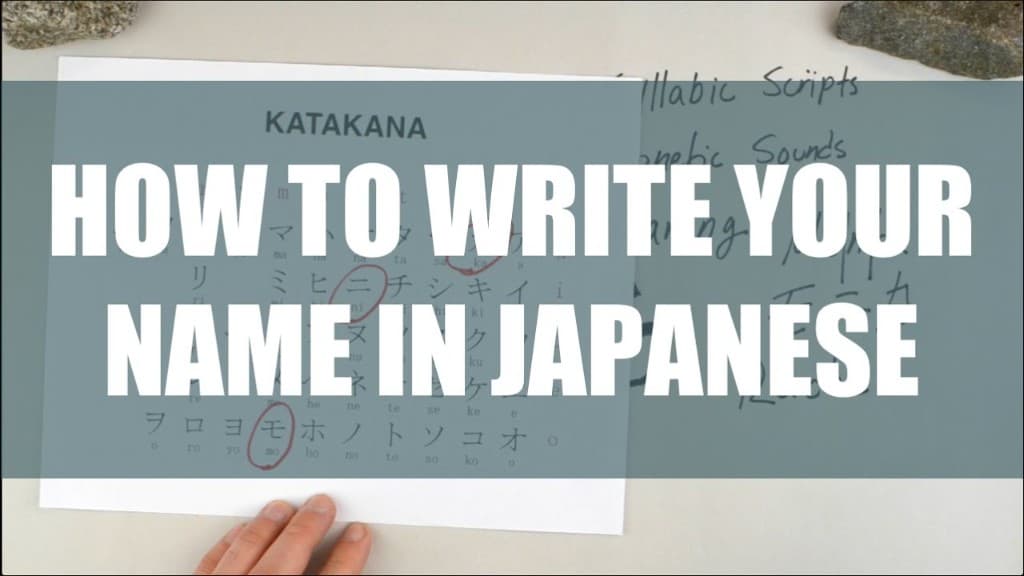
A practical guide for real people: how to write your name in Japanese using katakana, when to use hiragana, and how kanji name versions work without sounding awkward.
This guide covers how to write your name in japanese and related topics from the JapaneseNamer blog articles.
If you searched "how to write your name in Japanese", you are not alone. It is one of the most common questions people ask when they start learning Japanese, travel to Japan, or want a Japanese username that actually looks natural.
The short answer is simple: in most real situations, your name is written in katakana.
But there is a better answer than "just use katakana." This guide explains what to use, when to use it, and how to avoid the common mistakes that make names look unnatural.
First Rule: Foreign Names Usually Use Katakana
Japanese has three scripts: kanji, hiragana, and katakana.
For non-Japanese names, katakana is the normal script used in daily life:
- passports
- hotel bookings
- school records
- social profiles
- business forms
So if your name is Michael, Emma, David, Sofia, or Aisha, katakana is the default and correct choice.
If you want a quick conversion, use our My Name in Japanese tool. It gives you katakana, hiragana, and pronunciation in one place.
Why Your Name Changes in Japanese
Japanese sound structure is different from English. Most syllables end in a vowel, so foreign names are adjusted to fit Japanese pronunciation patterns.
That is why:
- "Chris" becomes クリス (Kurisu)
- "David" becomes デイビッド (Deibiddo)
- "Smith" becomes スミス (Sumisu)
This is normal, not a mistake. Japanese is mapping your name into its own sound system.
Common Name Examples
Here are practical examples many readers ask for:
- Michael -> マイケル
- Sarah -> サラ
- Emma -> エマ
- Daniel -> ダニエル
- Ryan -> ライアン
- Sophia -> ソフィア
- Ayesha/Aisha -> アイシャ
If you are unsure between two spellings, choose the one native speakers can read immediately without guessing.
Should I Use Hiragana for My Name?
Hiragana is not wrong, but for foreign names it is not the standard choice.
Use hiragana mainly as:
- a pronunciation helper for learners
- a soft stylistic choice in personal art or social bios
For official or practical usage, katakana is still the safe default.
What About a Kanji Version of My Name?
Many people ask this next: "Can I write my name in kanji?"
Yes, but this is usually creative/stylized, not official transliteration.
A kanji name can be built in two ways:
- sound-first: characters chosen to match pronunciation
- meaning-first: characters chosen for a meaning you like
Example idea:
- "Ema" could be written as 絵真 ("picture" + "truth")
This can look beautiful, but you should verify readings with a native speaker if you plan to use it seriously.
Fast 3-Step Method (No Overthinking)
1) Write the name in plain English
Use your most common spelling (the one on your documents/social profiles).
2) Convert to katakana
Use My Name in Japanese and check pronunciation.
3) Test readability
Read it out loud once. If it sounds smooth and close enough to your real name, keep it.
That is enough for most people.
Mistakes to Avoid
- Using random kanji you found on Pinterest without checking meaning
- Mixing katakana and hiragana in one name style for no reason
- Choosing a spelling that "looks cool" but is hard to read
- Assuming one English sound must map exactly (it usually does not)
Natural and readable always beats complicated.
Final Takeaway
If your goal is to write your name in Japanese the way real people use it, choose katakana first.
Then, if you want a more artistic identity, explore a kanji variation carefully.
If you want to try both instantly, start here:
Your Japanese name does not need to be perfect on day one. It just needs to be readable, respectful, and authentically you.
About the Author
Yuki Tanaka
Cultural researcher and linguist specializing in Japanese onomastics with over 12 years of academic study.
Last updated: